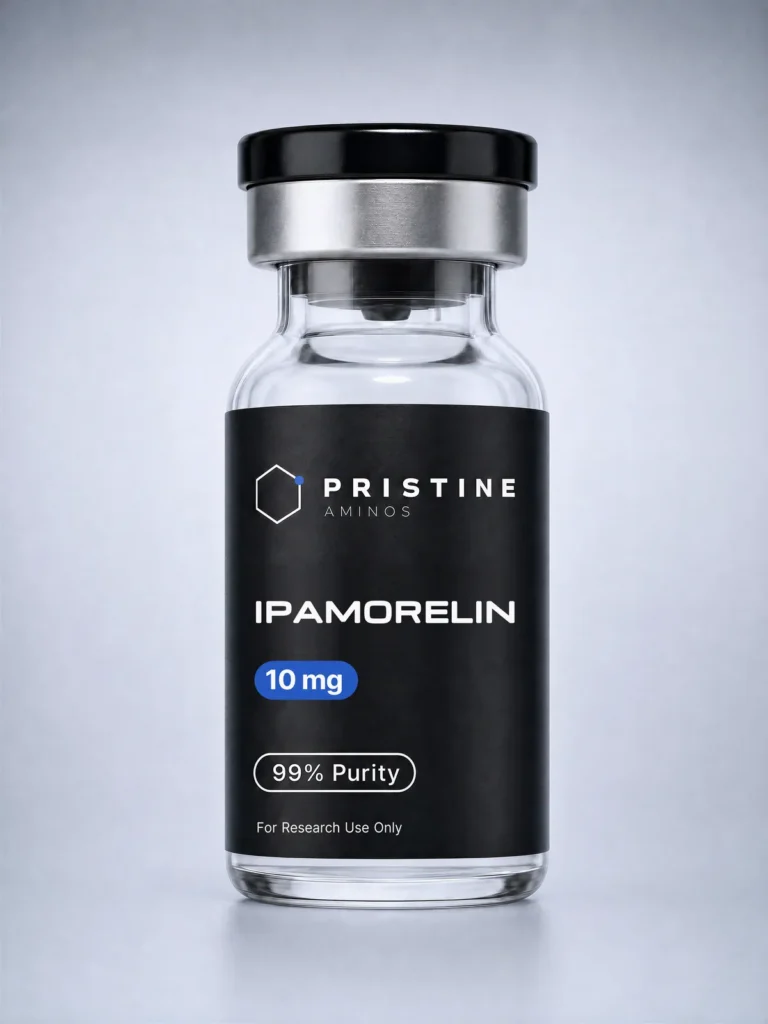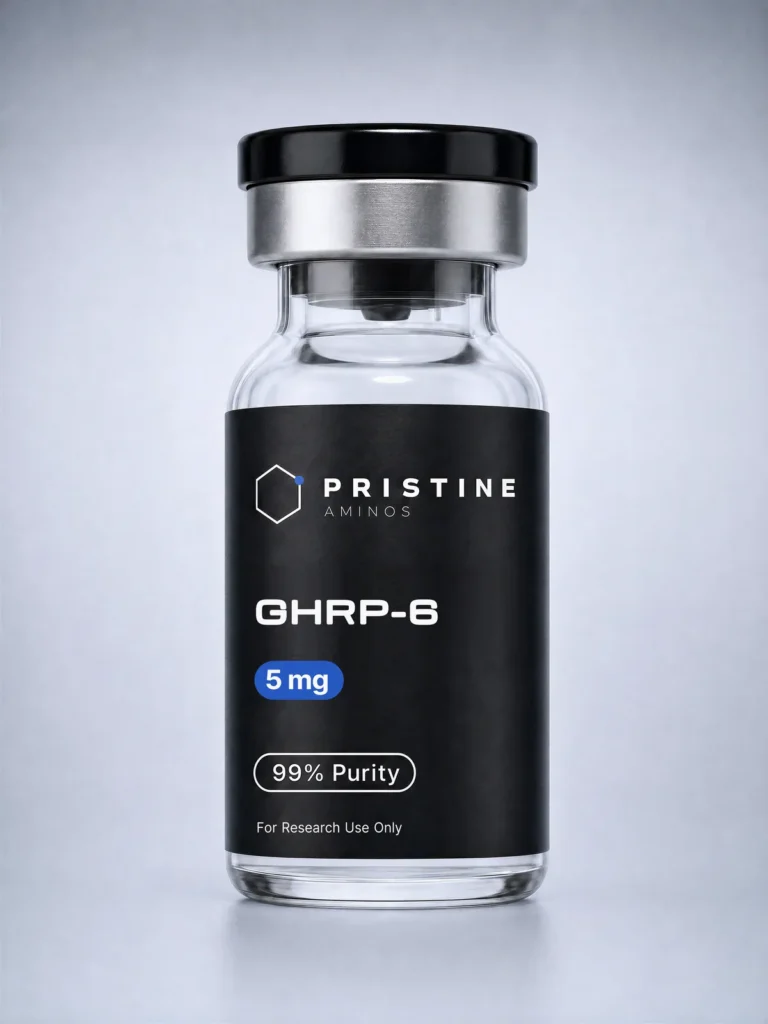



Ipamorelin and GHRP-6 are both studied as growth hormone secretagogues, but they’re not interchangeable research materials. In an ipamorelin vs. GHRP-6 comparison, the useful questions are how each is classified, what signaling endpoints a study measures, and whether the tested lot is traceable.
What Are Ipamorelin and GHRP-6?
Ipamorelin is a synthetic pentapeptide, meaning it contains five amino-acid residues. It belongs to the growth hormone secretagogue peptide class. Its sequence is Aib-His-D-2-Nal-D-Phe-Lys-NH2.
GHRP-6 is a synthetic hexapeptide, with six amino-acid residues. It is also classified as a growth hormone secretagogue. For compound identification, researchers can consult the ipamorelin sequence reference and the GHRP-6 compound sheet alongside their own lot records.
Both compounds are studied in relation to the growth hormone secretagogue receptor, often called GHS-R1a. A receptor is a cell protein that binds a signal and can trigger activity inside the cell. The receptor provides a shared mechanism for laboratory study, while the peptides retain distinct structures.
Laboratory comparisons can examine the peptides’ structures and receptor-related mechanisms under defined assay conditions.
That distinction shapes the research question. A study may examine how two peptides interact with a receptor pathway, or focus on how their different structures relate to measurements under one defined set of conditions.
How Their Receptor Signaling Is Studied
In vitro research can examine receptor activity in a controlled cell system. Researchers choose the cell model, define the test conditions, then measure a planned endpoint. For a secretagogue study, that endpoint may include the amount of growth hormone released by pituitary cells.
For a wider view of how this receptor class compares with GHRH analogs, see GHRH analogs vs. ghrelin receptor agonists.
| Study angle | Ipamorelin | GHRP-6 | What to keep in view |
|---|---|---|---|
| Peptide class | Pentapeptide secretagogue | Hexapeptide secretagogue | Different structures can affect assay behavior. |
| Receptor pathway | GHRP-like receptor signaling | GHRP-like receptor signaling | Shared pathway does not mean identical response. |
| Published cell endpoint | Growth hormone release | Growth hormone release | Keep the cell model and assay conditions aligned. |
| Reported response in primary rat pituitary cells (Raun et al., 1998) | EC50 1.3 ± 0.4 nmol/L; Emax 85 ± 5% | EC50 2.2 ± 0.3 nmol/L; Emax 100% | Values are study-specific. |
EC50 is the concentration that produces half of a measured maximum response in a defined assay. Emax is that assay’s maximum response. Neither measure describes every possible model, so use them as study-specific reference points rather than fixed properties.
When comparing results, hold the cell model and readout steady. If those change along with the peptide, it becomes harder to tell which variable caused a shift in the measured response.
What the Differences Mean for In Vitro Study Design
Start with the question, not a presumed winner. If you’re examining receptor activity, define which signal you’ll measure and how you’ll distinguish receptor-driven activity from background response. If you’re comparing peptide structure, keep the cell system and assay conditions consistent across both compounds.
The published cell assay offers one example of a useful comparison: it reports both EC50 and maximum response for each peptide in the same model, primary rat pituitary cells. That paired view matters because a concentration associated with half-maximal response and the highest measured response answer different questions. One value alone can’t summarize the full curve.
Build the experimental record around variables that could affect interpretation. Note the cell model, test conditions, peptide identity, lot identifier, measurement method, and analysis approach. If a result differs from the published cell assay, check whether the protocol and endpoint match before treating the difference as a compound effect.
Set controls before testing. A vehicle control helps show the baseline under the assay conditions. A suitable reference control can help confirm that the assay responds as planned. Use the controls that fit your validated model, and document why they were selected.
Do not extend an in vitro result beyond the system that produced it. Cell assays can help characterize a mechanism under controlled conditions; they do not, on their own, establish outcomes beyond that model. The most useful comparison is the one with a clear endpoint and a record another researcher can follow.
Evaluating Research Material and Batch Documentation
Research interpretation depends on knowing what material entered the assay. A batch-specific Certificate of Analysis, or COA, ties documentation to a particular lot. Check that the lot identifier on the document matches the material record in your lab, then retain both with the study notes.
A purity result is easier to assess when its analytical method and lot are clear. Read the COA for the information it actually provides, and don’t treat a single purity figure as proof of every other quality attribute.
Traceability also matters during a handoff. If procurement receives a lot and a researcher later runs the assay, both teams need a shared lot identifier. That simple link makes it easier to review the record if a result needs investigation or a study is repeated.
Pristine Aminos sells research-use-only compounds made in the USA and publishes a COA for every product. Researchers can review the ipamorelin research material and the GHRP-6 research material, with the available documentation, before making a procurement decision.
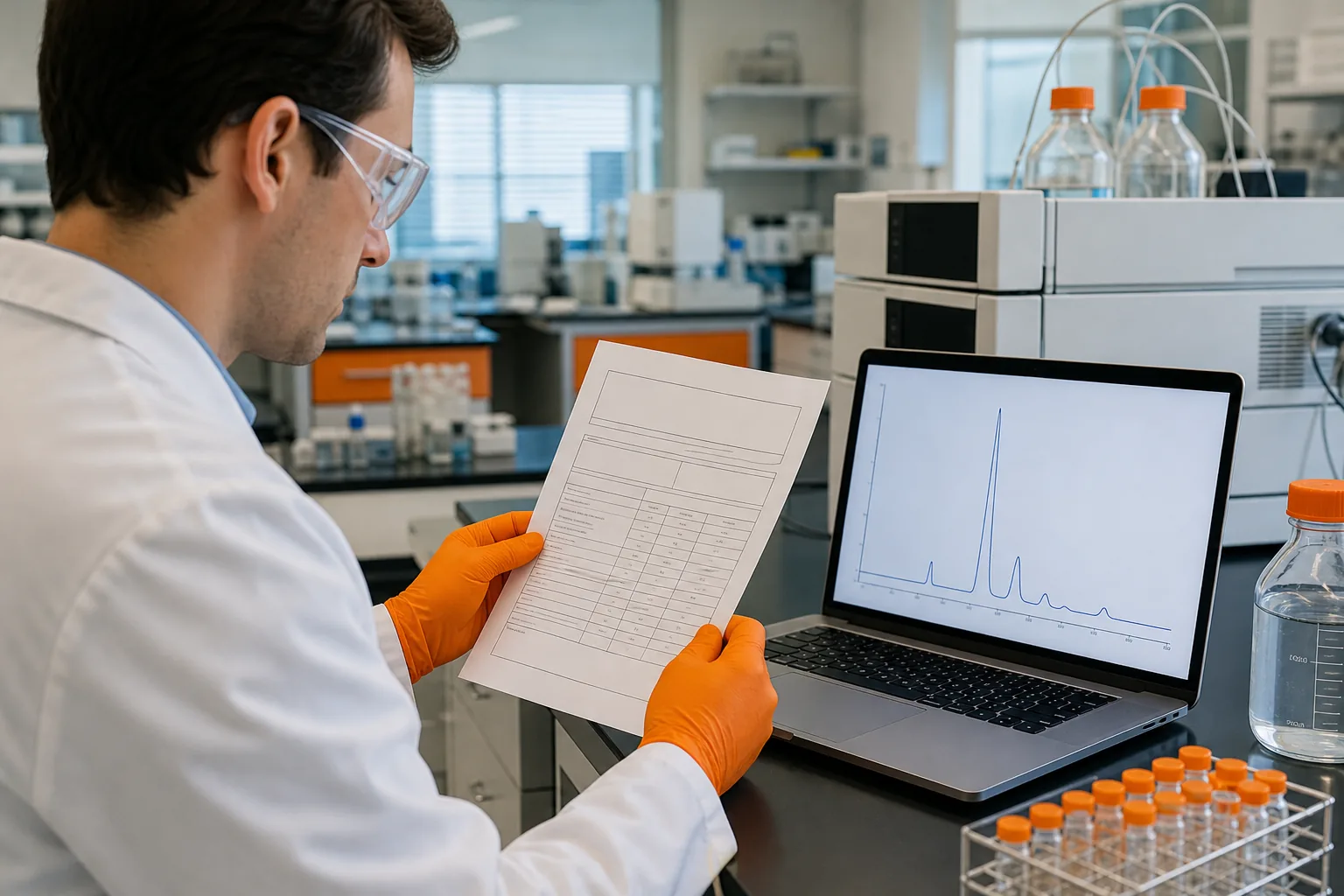
For any supplier, look for a clear match between the material, lot record, and analytical document. If a report does not answer a question that matters to your assay, ask for clarification before the study begins.
Frequently Asked Questions
What is the main difference between ipamorelin and GHRP-6?
Ipamorelin is a pentapeptide, while GHRP-6 is a hexapeptide. Both are studied in laboratory assays involving a GHRP-like receptor pathway. A published cell assay reported different EC50 and maximum-response values for the two peptides under its specific conditions, so researchers should treat those measurements as model-specific rather than universal.
Do ipamorelin and GHRP-6 act on the same receptor?
Both have been studied for activity through a GHRP-like receptor pathway. That shared pathway provides a basis for comparison, but assay conditions still shape the measured response. A study should state its cell model and endpoint rather than assume that two peptides produce identical signaling.
What do EC50 and Emax mean in a peptide study?
EC50 is the concentration linked to half of the measured maximum response in a defined assay. Emax is the maximum response observed in that assay. They describe different parts of a response curve. When you compare reported values, check that the model and measurement conditions match closely enough to support the comparison.
What should a peptide COA help a lab verify?
A COA should help connect a specific lot to its analytical record. Match the lot identifier on the document with the material received and the record used in the assay. Review the stated test method and the reported results, then retain the document with your study files. A COA’s scope depends on what the document reports.
Conclusion
For an in vitro comparison, choose the peptide that fits your defined research question, then keep the model, endpoint, and lot record clear. Before procurement, review the relevant compound sheet and the COA; Pristine Aminos publishes a COA for every product. Research materials are for laboratory research only, not human or veterinary use.