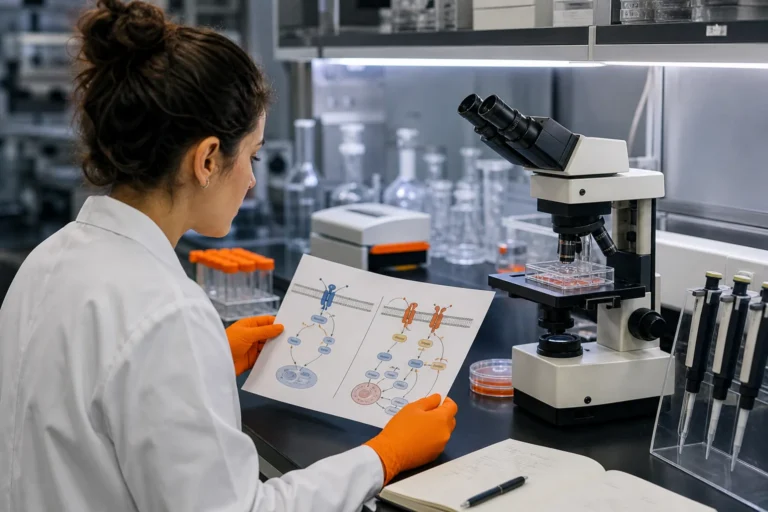


SLU-PP-332 belongs to one of the most intriguing categories in metabolic research: the exercise mimetics, compounds studied for reproducing parts of the cellular adaptation normally earned through endurance training. This primer explains the receptor family it targets, how it was developed, what the animal studies show, what “exercise in a molecule” can and cannot mean, and how to work with a small-molecule nuclear receptor agonist in the laboratory.
What Endurance Training Does to a Muscle Cell
Repeated endurance exercise remodels muscle at the level of gene expression. Fibers shift toward the slow-twitch, oxidative type; mitochondria multiply and become more efficient; the enzymes of fatty-acid oxidation increase; new capillaries form. Much of this program is coordinated by a small set of transcription factors and co-activators, with PGC-1α as the master co-activator and the estrogen-related receptors as the transcription factors it most often partners with. The question exercise-mimetic research asks is whether switching on that network pharmacologically reproduces the adaptation.
The Target: Estrogen-Related Receptors
Despite the name, ERRs do not bind estrogen. They were named in 1988 for their sequence similarity to the estrogen receptor and are orphan nuclear receptors, transcription factors with no confirmed natural hormone ligand. There are three: ERRα, ERRβ, and ERRγ. All three regulate genes governing mitochondrial biogenesis, oxidative phosphorylation, and fatty-acid oxidation, and ERRγ in particular drives the oxidative muscle fiber program. ERRα is the most widely expressed and is the main partner of PGC-1α in muscle, heart, and brown fat. Because ERRs are constitutively active (they switch genes on without a ligand), a synthetic agonist works by stabilizing the active conformation and recruiting more co-activator, amplifying a signal that is already on.
The Compound
SLU-PP-332 was developed at Saint Louis University (the “SLU” in the name) and reported in 2023. It is a small synthetic molecule, not a peptide, that acts as an agonist at all three ERRs, with the strongest activity at ERRα. It was designed as a tool compound to test whether ERR activation alone could reproduce the exercise transcriptional program, and it is the first potent pan-ERR agonist suitable for animal studies, which is why it attracted immediate attention.
What the Preclinical Work Shows
In mice, SLU-PP-332 increased the proportion of oxidative (type IIa) muscle fibers, raised mitochondrial content and fatty-acid oxidation in muscle, and improved running endurance by a substantial margin in treadmill tests, all without a training stimulus. In diet-induced metabolic-model mice it increased energy expenditure and reduced fat mass without changing feeding-pathway or activity. Gene-expression profiling of treated muscle showed a signature overlapping heavily with that of exercise-trained muscle, the transcriptional fingerprint of training appearing without training. Heart muscle showed increased oxidative gene expression as well. These are the findings that defined the compound’s research role: a probe for asking which benefits of exercise are downstream of ERR activation specifically, and which require something else (mechanical load, calcium signaling, AMPK, hypoxia) that a transcription-factor agonist does not supply.
What an Exercise Mimetic Is Not
The phrase invites overstatement. Exercise acts through many parallel pathways, and a compound that activates one of them reproduces one slice of the adaptation. SLU-PP-332 does not strengthen tendons, remodel bone, improve coordination, or deliver the cardiovascular conditioning that comes from repeated increases in cardiac output. In research, that limitation is the point: by isolating the ERR slice, the compound lets a laboratory measure how much of a given exercise benefit that slice accounts for. The compound is also very new, with a literature of a few papers from essentially one group, and independent replication is the obvious next step.
Open Questions
- Which ERR matters most. A pan-agonist cannot distinguish ERRα from ERRγ contributions; isoform-selective compounds and knockout models are needed.
- Durability. Whether the induced fiber-type shift persists after the compound is withdrawn, as training adaptations partially do, is untested.
- Tissue effects beyond muscle. ERRs are active in heart, kidney, liver, and brown fat; the consequences of pan-activation in each are being mapped.
- Metabolic trade-offs. Increasing oxidative metabolism raises reactive oxygen species production; whether antioxidant defenses keep pace is a natural question for pairing with redox studies.
Research Context
SLU-PP-332 pairs naturally with mitochondrial compounds. MOTS-C is itself studied in exercise physiology and acts upstream through AMPK, a different arm of the same adaptation; SS-31 protects the mitochondrial membranes that ERR activation asks to work harder; and NAD+ supplies the coenzyme that increased oxidative metabolism consumes. A design that combines ERR activation with mitochondrial readouts (oxygen consumption, mitochondrial DNA copy number, PGC-1α and TFAM expression) is the natural experiment. See Mitochondrial Research Compounds Compared.
Handling a Small-Molecule Agonist
As a non-peptide small molecule, SLU-PP-332 does not follow peptide handling rules. It is poorly water-soluble and is typically dissolved first in DMSO to make a concentrated stock, then diluted into aqueous medium for use, keeping the final DMSO concentration low enough (usually under 0.1%) not to affect cells. Store the solid cold, dry, and dark; store DMSO stocks frozen in aliquots to avoid repeated freeze–thaw and water uptake (DMSO is hygroscopic). Protect from light. A Certificate of Analysis should confirm identity by mass spectrometry and purity by HPLC, as for any research compound; see What a COA Tells You. Find it in the Immunology Research collection, third-party verified.
All products discussed are intended strictly for in-vitro research and laboratory use only. They are not for human or veterinary use, consumption, or therapeutic application.