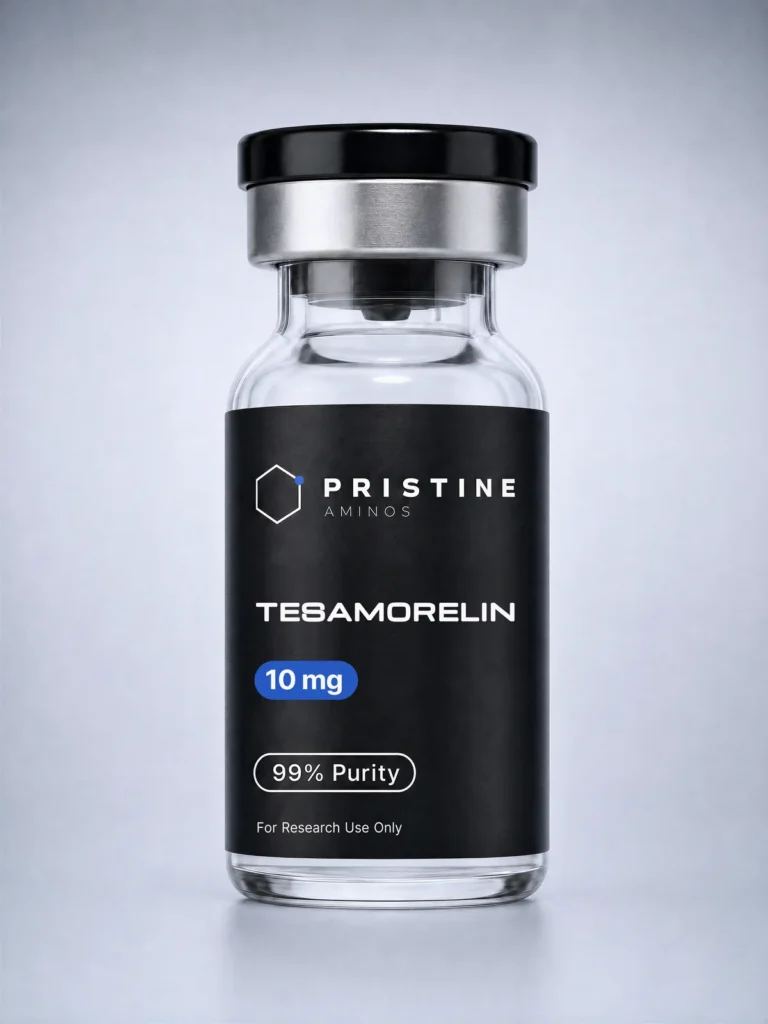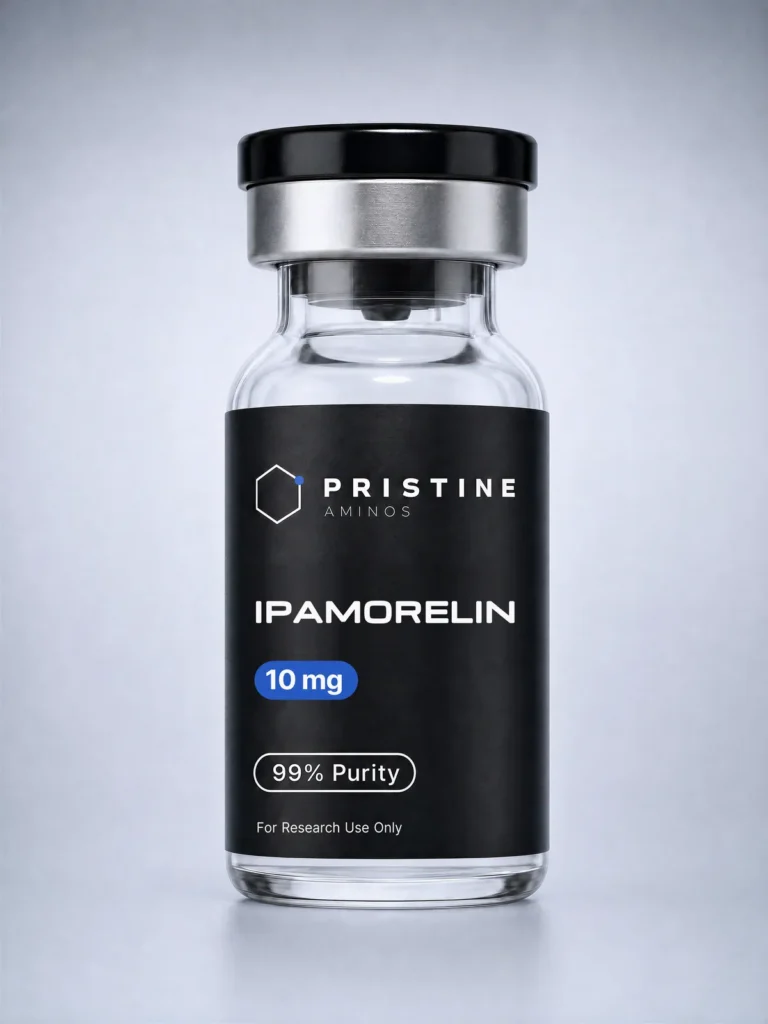


Ipamorelin and tesamorelin both relate to growth-hormone signaling, but they probe different receptors. In laboratory research, the useful comparison is their molecular design, signaling path, and the evidence a specific lot can support.
This guide explains those differences and shows how to assess identity, documentation, and handling before a study begins.
What Ipamorelin and Tesamorelin Are: Different Molecular Approaches
Ipamorelin is a synthetic pentapeptide, meaning its chain contains five amino-acid residues. It is studied as an agonist of GHS-R1a, also called the ghrelin receptor. Its defined sequence is Aib-His-D-2-Nal-D-Phe-Lys-NH₂, and its reported molecular weight is 711.9 Da.
That sequence includes several features that differ from a simple chain of standard L-amino acids. Aib is a non-standard amino acid. D-2-Nal and D-Phe are mirror-image forms of their usual L counterparts. The chain also ends in an amide group. These details matter because a residue swap or a change at the chain end creates a different chemical identity, even if the label still says ipamorelin.
For a focused review of the compound’s identity and lab context, the Pristine Aminos ipamorelin compound sheet is a useful companion. A published 1998 study describes ipamorelin as a selective growth hormone secretagogue in experimental models, but that work does not make all lots analytically equivalent.
Tesamorelin is a synthetic, modified 44-amino-acid analog of growth hormone-releasing hormone, or GHRH. Its defining structure includes a trans-3-hexenoyl group attached to the N-terminus of the peptide, as described in a 2007 non-clinical evaluation. That chemical modification is intended to reduce one route of enzymatic breakdown while preserving the receptor-facing part of the molecule.
So the comparison begins with two distinct designs. Ipamorelin is a short ligand studied at GHS-R1a. Tesamorelin is a longer GHRH analog studied at GHRHR. The difference is not a matter of one being a shorter version of the other.
Mechanism of Action: Ghrelin-Receptor Signaling vs. GHRH-Receptor Signaling
Receptor choice sets the first step in a signaling experiment. Ipamorelin is studied through GHS-R1a, while tesamorelin is studied through the GHRH receptor, often written GHRHR. The pathways may connect to related downstream systems, but they do not start at the same molecular switch.
GHS-R1a is a G-protein-coupled receptor. In receptor studies, researchers can test whether a ligand binds or activates this receptor, then track downstream cellular signals. Ipamorelin is commonly treated as a selective research ligand for that question. A receptor-negative or receptor-blocked condition can help distinguish a target-linked response from a general change in the cells.
GHRHR is also a G-protein-coupled receptor, but it belongs to a different receptor family. GHRHR signaling couples mainly through Gs, which can raise cyclic AMP inside a cell and engage protein kinase A. That gives researchers measurable readouts, such as cAMP assays or reporter systems, when the model expresses a working receptor.
Signal timing also matters. A brief pulse and a sustained exposure may not produce the same pattern. Receptors can change their response after repeated or continuous stimulation, while the ligand itself may break down in the assay medium. With tesamorelin, the N-terminal modification is relevant to this second issue because it is designed to protect against a specific cleavage route. That feature does not remove the need to check stability in the actual assay conditions.
When choosing between the compounds, start with the receptor your experiment is meant to test. A GHS-R1a assay calls for a ligand selected for that receptor. A GHRHR assay calls for a GHRH-family ligand. If the study compares pathways, treat each as its own condition and build matched controls around each receptor system.
Receptor identity is a better starting point than broad labels such as “growth-hormone peptide.” The broader label describes a research area, not an interchangeable assay reagent. For a wider view of the two receptor families, see the guide to GHRH analogs vs. ghrelin receptor agonists in research. For a comparison within the ghrelin-receptor class, see ipamorelin vs. GHRP-6.
What the Research Evidence Can and Cannot Show
Evidence has to be read at the level it was produced. A receptor assay can show activity in a defined cell system. An animal study can show a response in that model. Neither design automatically answers a different question, such as how a compound behaves in another cell type or under another assay condition.
For ipamorelin, the sequence and molecular weight give researchers concrete identity checks to plan around. The sequence implies that mass alone is not enough to verify every structural detail. D- and L-amino acids have the same mass, so a mass result cannot by itself confirm the stereochemistry at the D-residue positions. Where stereochemistry affects the research question, the synthesis record or a suitable chiral method can add useful confirmation.
Tesamorelin requires a different identity check. The expected mass needs to match the modified, acylated 44-residue structure, not merely an unmodified backbone. A method that confirms the peptide’s mass can help distinguish those forms. Peptide mapping or tandem mass spectrometry may be appropriate when a study needs residue-level detail, but the method should fit the question and the lab’s validation plan.
Purity and identity answer different questions. Reversed-phase HPLC estimates the share of the detected signal associated with the main peak. Mass spectrometry checks whether the measured mass fits the expected molecule. A high purity figure cannot, on its own, prove the main peak has the right sequence. A mass match cannot, on its own, show that a sample contains few related impurities.
Evidence for a signaling mechanism also does not settle the performance of a specific lot. Researchers still need to review the batch record, compare analytical methods, and decide whether the documented tests cover the study’s risks. If an assay is sensitive to contaminants, a purity result alone may not answer every relevant quality question.
The available comparison should therefore stay narrow: these compounds have different structures and receptor targets, and published experimental findings support study of those distinct mechanisms. Claims beyond the tested model need separate evidence. A useful lab decision is one tied to an assay, a defined readout, and the quality attributes needed to interpret it.
Choosing a Compound for a Laboratory Research Question
Write the research question before selecting a material. If your hypothesis concerns GHS-R1a activation, ipamorelin aligns with that receptor-focused question. If it concerns GHRHR signaling, tesamorelin aligns with the GHRH-analog pathway. If you need to compare both, plan parallel assays rather than treating one compound as a stand-in for the other.
Next, define the readout. A receptor-binding assay, a cAMP assay, and a gene-reporter assay do not measure the same event. The first can address receptor interaction. A second can track a downstream signal. A reporter can show a later response shaped by the cell model and the timing of the experiment.
Model fit matters. Confirm that the selected cells express the receptor you intend to study, and include controls that help separate receptor-dependent activity from nonspecific effects. If the cell system has little or no target receptor, a weak response may reflect the model rather than the peptide. That is a design problem, not a reason to assume the compounds are interchangeable.
Plan for ligand stability too. Tesamorelin’s structural modification addresses a known cleavage liability associated with native GHRH. Ipamorelin’s non-standard and D-amino-acid residues give it a different structural profile. Neither point replaces testing under the assay’s own buffer, temperature, and incubation conditions.
Finally, decide what documentation your study requires. A basic screening assay may need a lot-specific identity check and a stated purity method. A sensitive cell assay may need additional information chosen with the assay’s readout in mind. The record should let another researcher connect the material used to the result reported.
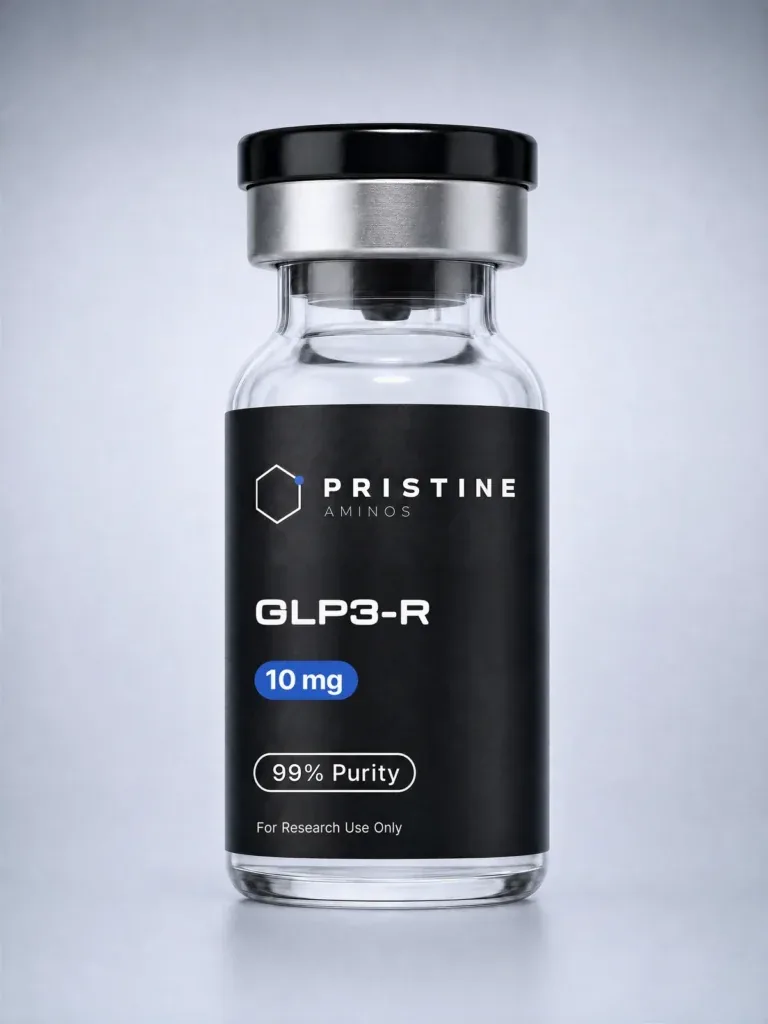
The Pristine Aminos tesamorelin compound sheet can help orient a study around the GHRH analog’s identity. The matching tesamorelin research material page and ipamorelin research material page are relevant when checking the product record against the planned research use.
Comparing Research Materials: Identity, Documentation, and Procurement
Supplier documentation is part of the experimental record. Before a material enters a study, check whether its lot-specific Certificate of Analysis, or COA, identifies the same lot number shown on the container. A generic product sheet cannot establish that a particular batch was tested.
Look for separate results for identity and purity. For ipamorelin, the expected mass should account for its terminal amide. The known sequence also includes D-amino acids, so a mass result alone cannot establish their configuration. For tesamorelin, confirm that the expected mass reflects the N-terminal modification. These are molecule-specific checks, not one universal checklist applied without thought.
For an HPLC result, examine whether the report identifies the method and shows a chromatogram. A percentage is easier to interpret when the separation conditions and integrated peaks are available. If the study depends on net peptide content or a particular salt form, make sure those values are documented well enough to support the concentration calculations used by the lab.
Traceability should connect the vial, COA, and notebook entry. Record the lot identifier when material arrives. Then preserve the COA with the experiment file and note the lot used in each run. If a result shifts between batches, this link helps the team ask whether the assay changed or the material did.
Pristine Aminos states that its research-use-only products are made in the United States and third-party tested, with a COA for every product published on its testing page. Those are procurement and traceability details. They do not replace your own assessment of whether the available documentation fits a given assay.
For any research material, compare what the COA measures with what the study needs to know. Do not treat one purity number as a complete quality profile. If a required attribute is not part of the evidence you have, define that gap as a study requirement before procurement, rather than assuming an unrelated result covers it.
Laboratory Handling, Storage, and U.S. Research-Use Boundaries
Peptide handling can affect the sample before it reaches an assay. Lyophilized material is generally kept sealed, dry, and protected from light. For longer storage, cold conditions are commonly used. Follow the lot documentation and your institution’s handling procedures rather than applying a single storage rule to every peptide.
Let a cold, sealed vial reach room temperature before opening. This helps limit moisture forming on a cold sample when it meets warmer room air. Moisture can affect a lyophilized peptide over time, so keep the vial closed until it has equilibrated and return it to suitable storage after sampling.
Once material is in solution, stability can change. Hydrolysis, oxidation, aggregation, and adsorption to container surfaces may affect recovery or assay response. Repeated freeze-thaw cycles can also add variation. When the method permits, plan aliquots that reduce repeated access to the same sample, and record the preparation date and storage conditions.
Vehicle choice belongs in the assay design. The solvent or buffer should suit the peptide and the experimental system. Match the vehicle in the control condition so that any signal from the solvent is not mistaken for a peptide-linked effect. If dissolution is slow or the solution appears hazy, pause and assess the sample against the lab’s acceptance criteria instead of assuming it is ready.
Cell-based studies may be sensitive to contaminants that do not affect a simple identity or purity reading. Endotoxin, for example, can activate innate immune pathways and complicate some cellular readouts. Sterility and endotoxin are separate questions, so one result cannot stand in for the other. Include only the tests that fit the application and the lab’s research requirements.
Pristine Aminos identifies its materials as research-use-only and intended for laboratory work. Research teams remain responsible for institutional review, safe handling, and applicable U.S. requirements. Keep the material within the research setting described by its documentation.
Frequently Asked Questions
Are ipamorelin and tesamorelin the same type of peptide?
No. Ipamorelin is a five-residue peptide studied at GHS-R1a, while tesamorelin is a modified 44-amino-acid GHRH analog studied at GHRHR. Their structures and receptor targets differ. For lab planning, that means each compound should be matched to a distinct receptor question, assay design, and set of identity checks.
Which receptor does ipamorelin target in laboratory research?
Ipamorelin is studied as an agonist of GHS-R1a, also called the ghrelin receptor. A receptor-focused experiment should confirm that the model expresses the target and should include controls suited to the assay. The material’s identity and batch record also matter when interpreting a signal.
How does tesamorelin differ structurally from GHRH?
Tesamorelin is a synthetic 44-amino-acid GHRH analog with a trans-3-hexenoyl group attached to its N-terminus. That modification is designed to reduce a specific enzymatic cleavage route. For identity checks, the expected mass should represent the modified peptide rather than an unmodified GHRH backbone.
Can HPLC alone confirm a peptide’s identity?
No. Reversed-phase HPLC estimates purity by separating the main signal from other detected components, while mass spectrometry checks whether the measured mass fits the expected molecule. These methods answer different questions. For some structural features, such as D-amino-acid configuration, additional evidence may be needed.
What should a research peptide COA contain?
A useful COA should identify the lot and show the analytical results relevant to the study. Researchers commonly look for a clear identity method and a stated purity method, with enough detail to interpret each result. The exact information needed depends on the molecule and assay, so set those requirements before procurement.
Conclusion
Choose by receptor and assay question: ipamorelin fits GHS-R1a research, while tesamorelin fits GHRHR research. Before ordering, review the relevant compound sheet and the batch record, then confirm that the documentation matches your assay needs. Both materials are supplied for laboratory research use only and are not for human or veterinary use.