

BPC-157 is one of the most frequently cited compounds in preclinical tissue-repair research, and also one of the most misunderstood. The literature is large but comes almost entirely from animal and cell-culture work, and much of it from a single research group. This article summarizes what that record actually contains, where it is strong, where it is thin, and what a laboratory should keep in mind when working with the material.
What BPC-157 Is
BPC stands for “Body Protection Compound.” BPC-157 is a synthetic 15-amino-acid peptide (Gly-Glu-Pro-Pro-Pro-Gly-Lys-Pro-Ala-Asp-Asp-Ala-Gly-Leu-Val) whose sequence corresponds to a fragment of a larger protein isolated from human gastric juice. It has a molecular weight of roughly 1,419 Da and no disulfide bonds, which makes it comparatively simple to synthesize and characterize.
Two physical properties set the research agenda. First, the peptide is reported to be stable in gastric juice for 24 hours or more, which is unusual for a peptide and is why so many of the published experiments use oral administration in rodents. Second, it is highly water-soluble, which simplifies in-vitro work compared with more hydrophobic sequences.
Where the Research Comes From
The majority of the published studies originate from Predrag Sikiric’s group at the University of Zagreb, which has investigated the peptide since the early 1990s. That concentration matters when weighing the evidence: the findings are internally consistent and span hundreds of papers, but independent replication from unrelated laboratories is comparatively limited. A smaller number of groups in Asia and the United States have published on tendon fibroblasts, muscle injury, and vascular models.
Researchers reading this literature should also note that nearly all of it is preclinical. There are no published, peer-reviewed, controlled human trials of BPC-157. Anything described as a human effect is extrapolation.
Research Models in the Literature
Tendon and ligament
Rat models of Achilles tendon transection and medial collateral ligament injury are the most cited. Reported endpoints include histological organization of the healing tissue, biomechanical load to failure, and functional gait scores. In-vitro work on cultured tendon fibroblasts reports increased cell migration and survival, with signaling traced through the FAK–paxillin pathway and growth-hormone-receptor expression.
Skeletal muscle
Crush and transection models of the gastrocnemius and quadriceps in rats report faster restoration of muscle fiber architecture and function compared with controls.
Gastrointestinal tissue
Given the peptide’s origin, gut models are extensive: NSAID-induced lesions, colitis models, fistula models, and anastomosis healing. The consistent theme is preservation or restoration of mucosal integrity under chemical or mechanical insult.
Vascular biology
A recurring mechanistic claim is that the peptide influences the nitric oxide system and promotes new vessel formation in injured tissue, with VEGFR2 signaling proposed as one mediator. Several papers describe “collateral pathway” activation after vessel ligation in rats.
Proposed Mechanisms
No single receptor for BPC-157 has been identified, which is an important gap. The mechanistic proposals in the literature cluster around four themes: modulation of the nitric oxide pathway, upregulation of growth-factor receptors and early growth-response genes, interaction with the dopamine and serotonin systems in central-nervous-system models, and angiogenic signaling via VEGF. Each has supporting data, but none has been tied to a defined binding event. Laboratories designing mechanistic experiments should treat these as hypotheses rather than established pathways.
Handling in the Laboratory
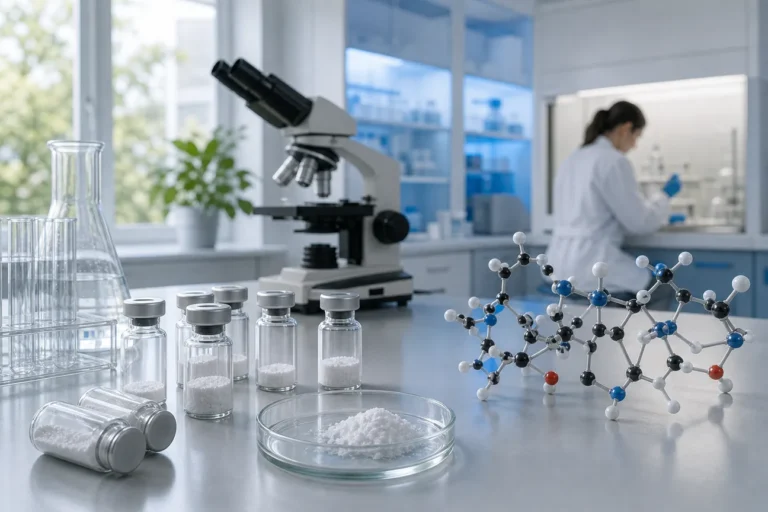
As a lyophilized powder, BPC-157 is stable for extended periods when stored cold, dry, and protected from light. Once reconstituted with bacteriostatic water, solutions should be refrigerated and used within a few weeks; see our guide to storing lyophilized peptides for specifics. Because the peptide contains no methionine, cysteine, or tryptophan, it is less prone to oxidation than many sequences, but the aspartate–glycine region is a candidate for slow isomerization in solution, so fresh preparations give the most reproducible results.
Identity and purity should be confirmed by Certificate of Analysis before use. The expected monoisotopic mass is about 1,418.7 Da; an HPLC purity above 99% is the standard for research material. Our article on how to read a COA walks through the relevant fields.
How BPC-157 Is Studied Alongside Other Compounds
BPC-157 is frequently paired with TB-500 in tissue-repair models because the two act through different proposed mechanisms, one angiogenic and the other cytoskeletal. We compare them in BPC-157 vs TB-500, and the combination is available as a single-vial BPC-157 + TB-500 blend for laboratories that want matched lots. It also appears in multi-peptide blends such as GLOW and KLOW with GHK-Cu.
Summary
BPC-157 has an unusually deep preclinical record for a research peptide, particularly in tendon, muscle, and gastrointestinal models, with consistent reports of accelerated repair. The weaknesses are equally clear: a single dominant research group, no identified receptor, and no controlled human data. For a laboratory, that profile makes it a well-characterized tool compound with a long list of open mechanistic questions.
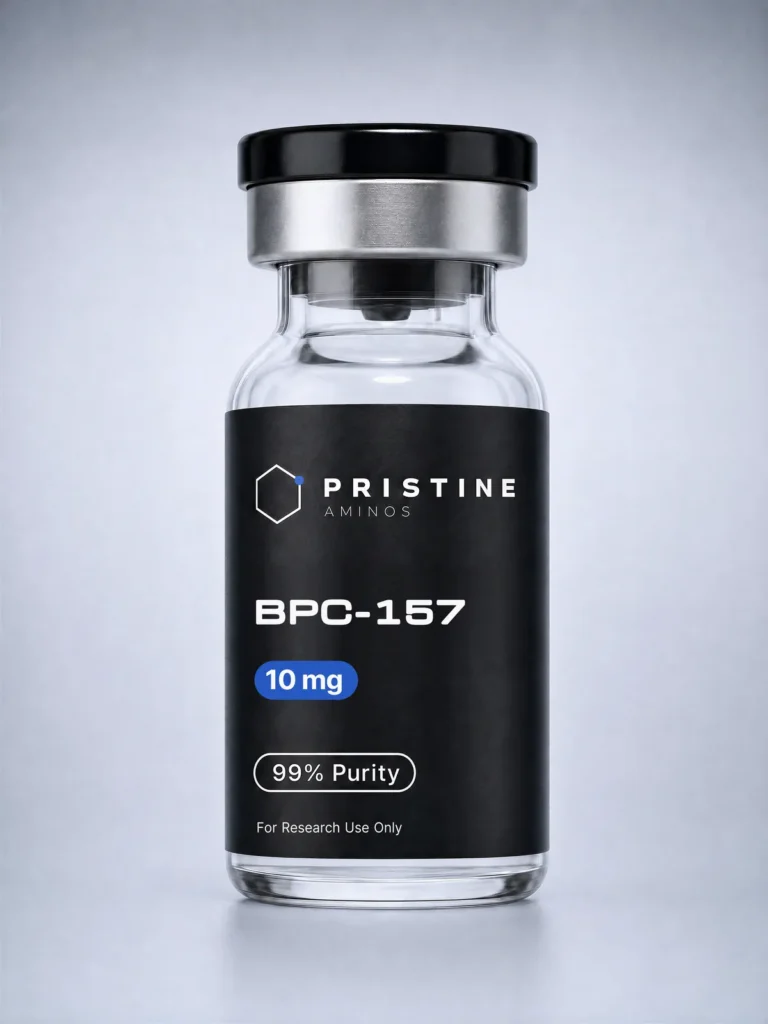
Pristine Aminos supplies BPC-157 as a lyophilized, third-party-tested research material in our Tissue Research collection.
For laboratory and research use only. Not for human or veterinary use, consumption, or therapeutic application.