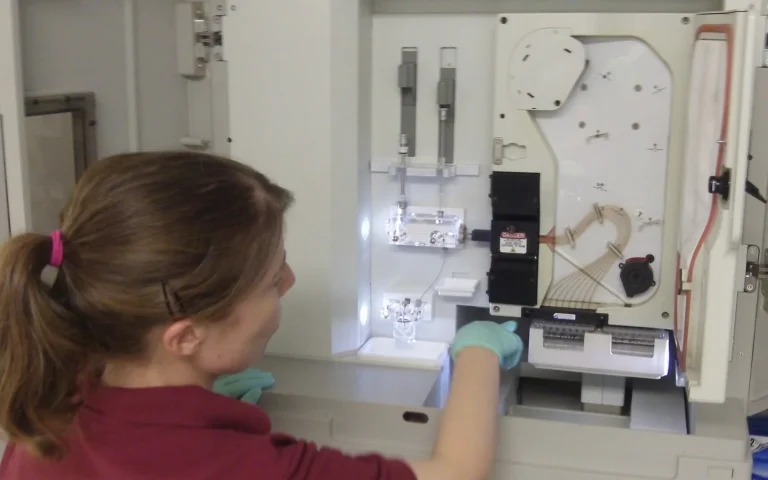


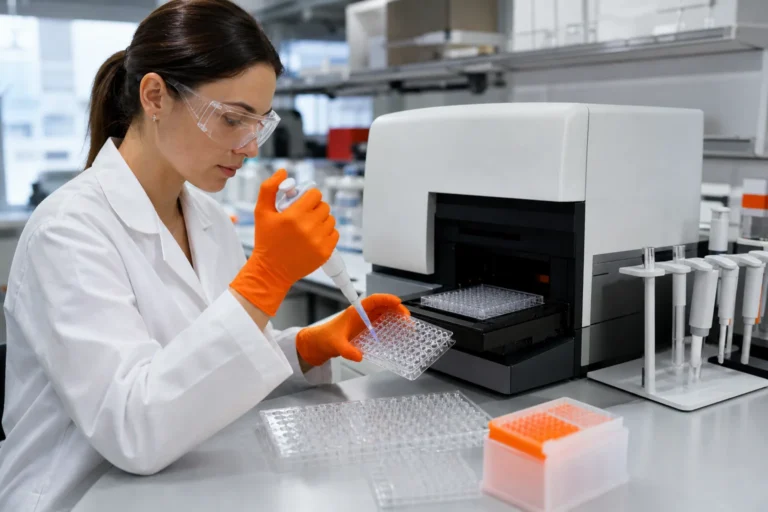
A peptide can look pure and still carry bacterial endotoxin. Peptide endotoxin testing checks for that contaminant, but a batch-specific certificate alone doesn’t prove the test was done or that the sample worked with the assay.
Here’s what the main methods measure, why peptide samples can skew results, and what to check on test documentation before using a lot in an experiment.
What Endotoxin Testing Measures in Peptide Samples
Endotoxins are lipopolysaccharides, often shortened to LPS, found in the outer membrane of Gram-negative bacteria. They can remain after bacteria are gone. Because endotoxin tolerates heat, a sterilization step such as autoclaving doesn’t by itself show that a sample is endotoxin-free.
That distinction matters in lab work. LPS can activate immune pathways and affect cell responses. If your experiment measures inflammation, immune signaling, or another sensitive response, endotoxin can look like an effect of the peptide. A result may then say more about contamination than about the peptide’s action at its target, such as a receptor.
Endotoxin tests look for this particular bacterial contaminant. They don’t establish sterility, confirm identity, measure purity, or detect every pyrogen. Those are separate checks. A separate purity assessment addresses peptide purity, but it isn’t an endotoxin result.
Testing may report a quantitative value in endotoxin units (EU) per milliliter or per milligram. A suitable limit test may instead report pass or fail against a stated threshold. The unit basis matters: a value per milligram can’t be read as a value per milliliter without knowing the sample concentration.
There isn’t one useful endotoxin limit for every research experiment. A limit set for a drug product may not fit an in vitro assay. Work backward from your model: determine the sample concentration used, then assess whether the reported result or limit could affect the response you measure.
Batch paperwork is useful only when it shows what was tested. A COA that lists purity and identity but has no endotoxin result doesn’t answer the endotoxin question. Pristine Aminos provides batch-specific documentation and makes its published batch testing results available for researchers to review. Check the specific lot and test shown, rather than treating a general quality claim as a test result.
How LAL and Recombinant Factor C Assays Differ
The Limulus amebocyte lysate test, usually called LAL, uses a reaction pathway that endotoxin activates. Depending on the format, the test detects a clot, a change in cloudiness, or a color signal. Different assay formats may be used as limit tests or to produce quantitative readings.
Recombinant Factor C, or rFC, uses a lab-made version of Factor C, the first endotoxin-sensing enzyme in the LAL pathway. When endotoxin activates it, the assay produces a measurable signal. Since rFC doesn’t include the separate Factor G pathway found in conventional LAL, it avoids one source of response to certain glucans. That can make the result more specific to endotoxin, though it doesn’t remove the need to check sample interference.
Recombinant assay formats can differ in how much of the cascade they rebuild and in the signal they produce. That affects the reader or instrument needed. Recombinant reagents are usually treated as additional validated options, not automatic replacements for LAL.
No assay wins for every sample. Choose based on the question, sample matrix, required sensitivity, and the method your lab can validate. For a research peptide, the key issue is whether the assay can recover a known endotoxin spike from that specific sample at the dilution you plan to use.
| Method | What creates the signal | Useful for | What to check |
|---|---|---|---|
| Kinetic chromogenic LAL | Color change over time | A quantitative endotoxin reading | The sample may cause color or other optical effects. |
| Recombinant Factor C | Signal from activated recombinant Factor C | Endotoxin detection without the Factor G branch | Fluorescence effects and matrix-specific recovery |
These methods don’t all produce the same kind of result. Read the method name before comparing values across certificates or labs.
Why Peptides Can Interfere With Endotoxin Assays
A negative reading can mean little endotoxin is present. It can also mean the peptide stopped the assay from seeing endotoxin. That’s why a clean standard curve alone doesn’t prove a peptide sample is compatible with the test.
Peptide chemistry can affect the reaction in several ways. A strongly charged peptide may bind LPS. A sample with a very acidic or basic pH can disrupt the assay chemistry.
Physical traits matter too. Aggregates, particles, or a cloudy sample can affect optical readings. A colored sample may alter a chromogenic result. Some sample components can also mask endotoxin, leading to low recovery. These effects depend on the formulation and test, so a result from a water control doesn’t settle the question.
Labs assess interference with a positive product control. They add a known amount of endotoxin to the peptide sample and measure how much the assay recovers. The sample is usually tested at a selected dilution, and the control helps show whether the matrix suppresses or boosts the signal. Recovery limits should follow the applicable validated or compendial method.
Don’t solve interference by diluting without a limit. Dilution can lower the effect of a troublesome matrix, but it also lowers the endotoxin level in the well. The maximum valid dilution is the boundary beyond which the assay may no longer detect endotoxin at the needed limit. Record the sample concentration and dilution so the reported value can be interpreted.
Sample handling also needs validation. Endotoxin can adsorb to surfaces, and a peptide may bind or mask it during a hold. If the test includes filtration or another pretreatment, controls should show what happens to the endotoxin through that full process. A water spike added only at the last step won’t reveal loss earlier in preparation.
Pristine Aminos lists third-party testing and batch-specific documentation for its research peptides. When you review any supplier’s records, including ours, look for a test that names endotoxin specifically rather than assuming that a purity result covers it.
How to Read Peptide Endotoxin Test Documentation
Start with the lot number. The COA or attached test report should match the vial or material record in front of you. Then find a distinct endotoxin or bacterial endotoxins entry. “Purity,” “sterility,” or “tested” on its own doesn’t show that endotoxin was measured.
Next, check the assay name and format. LAL is a family of methods, not one exact readout. Different assay formats and an rFC result can have different reporting formats. If the certificate says only “pass,” look for the method and the acceptance threshold behind that statement.
Read the result with its units and basis. EU/mL, EU/mg, and EU per vial refer to different quantities. If the report uses a less-than value, treat it as below the assay’s reporting bound, not as zero. The detection or quantitation limit helps show how low the method could measure under the stated test conditions.
Look for the sample concentration and dilution, plus evidence that the peptide matrix passed interference controls. A water standard curve confirms that the reagents worked in water. It doesn’t show that the peptide itself allowed endotoxin recovery. A positive product control result provides that matrix-specific check.
Also review the test date and laboratory identification, where provided. Batch traceability connects the report to a specific lot. It doesn’t tell you whether endotoxin was tested unless the report names the test. That’s the central distinction: batch-specific documentation is not a proxy for endotoxin testing.
Some supplier records are more detailed than others. One may name the exact LAL method, while another only states that endotoxin testing was done. Those differences show why it helps to ask for the method and limit, not just the COA.
At Pristine Aminos, each product has a COA, and the company describes its research peptides as third-party tested with 99%+ purity. Treat each claim according to what it measures. For purity results, see our guide to reading a research peptide COA; for endotoxin, verify that the lot’s record includes an endotoxin-specific result.
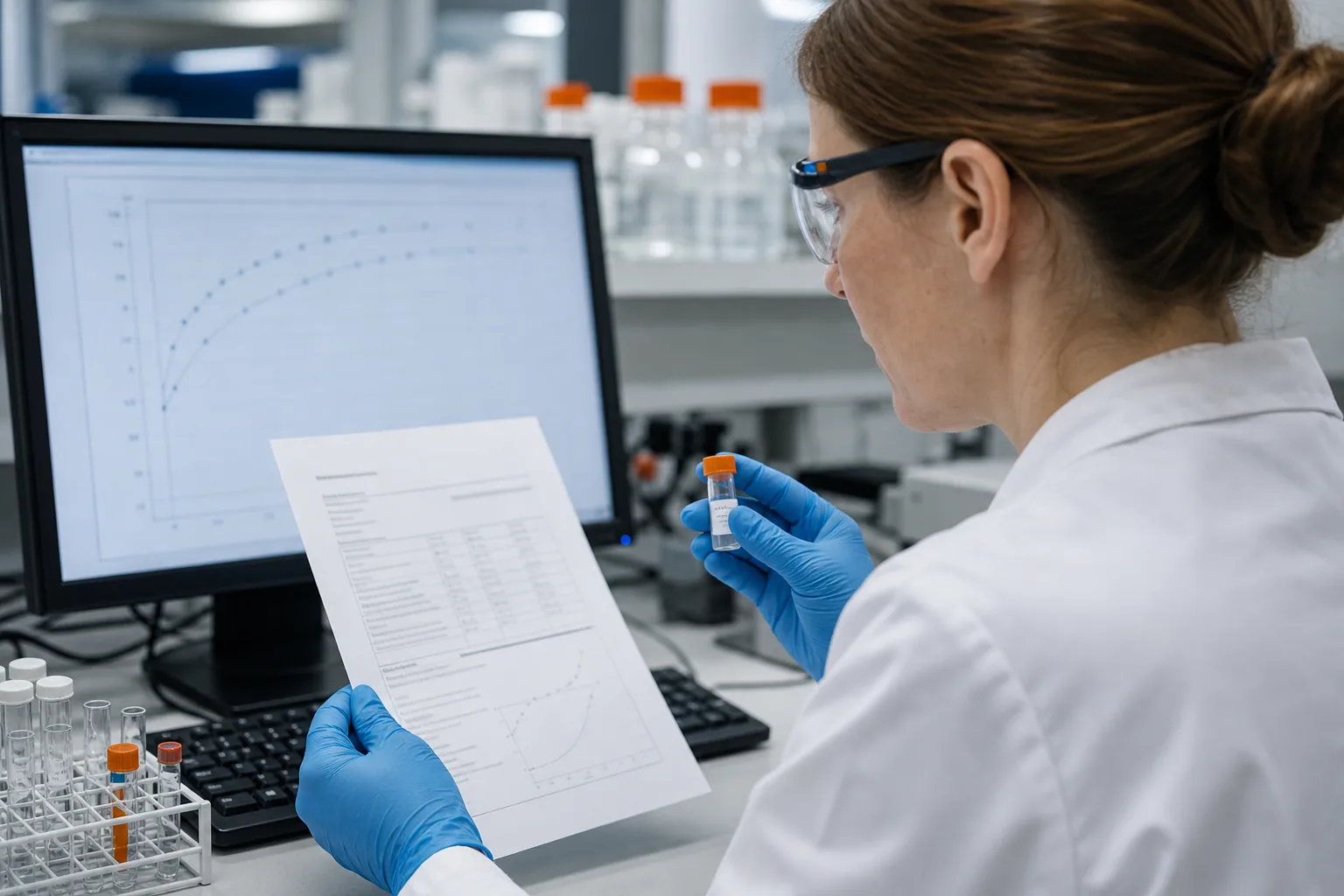
Finally, match the evidence to the experiment. If your model is sensitive to LPS, ask whether the result or stated limit is low enough for your use conditions. A certificate supports traceability and review; it cannot show contamination introduced after the test or answer questions the report doesn’t cover.
Frequently Asked Questions
What does an endotoxin test measure?
It measures bacterial endotoxin, the lipopolysaccharide (LPS) left by Gram-negative bacteria. It doesn’t establish sterility, peptide identity, or purity, and it isn’t a universal test for all pyrogens. Check the method and units on the report, since some tests give a numerical result while a valid limit test may report pass or fail.
Does a sterile peptide have to be endotoxin-free?
No. Sterility and endotoxin are different properties. A sterile sample may still contain endotoxin left behind after bacteria are removed or killed. If your experiment is sensitive to LPS, look for a separate endotoxin result and check whether the test included controls for the peptide matrix.
Is LAL better than recombinant Factor C?
Neither method is best for every peptide sample. LAL has several formats, while rFC uses a recombinant endotoxin-sensing enzyme and avoids the Factor G pathway that can respond to certain glucans. Sample interference, required sensitivity, and your lab’s validated method all affect the choice.
What should an endotoxin result on a COA include?
Look for the test name, method, result, units, acceptance limit, and lot link. A quantitative result should show its measurement basis, such as per milliliter or per milligram. For peptide samples, also seek the dilution and positive product control recovery, which help show that the matrix didn’t hide or exaggerate the signal.
Does a batch-specific COA prove endotoxin was tested?
No. A batch-specific COA connects results to a lot, but it proves endotoxin testing only if it includes an endotoxin-specific entry or a linked report that does. A general statement about testing or a purity result doesn’t answer whether endotoxin was measured for that batch.
Conclusion
Choose a test record that names the method, reports a clear limit or result, and shows matrix recovery for the peptide you’ll use. Before the next experiment, match the lot number to its COA and confirm the endotoxin result fits your model. For supplier background and documentation practices, read About Pristine Aminos.