

A peptide is a precise sequence of amino acids, and nearly everything in the environment conspires to break it. Understanding degradation science is part of running credible peptide research, because a degraded compound produces data about the degradation products, not the peptide. This article explains the chemical reactions that break peptides down, which residues are vulnerable to which reactions, why the lyophilized state is so much safer than solution, and how to read a sequence for its weak points. For the practical protocol, see Storing Lyophilized Peptides.
The Four Enemies
Heat accelerates every degradation reaction: hydrolysis of the backbone, oxidation of sensitive residues, deamidation, and aggregation. As a rule of thumb, reaction rates roughly double for every 10 °C rise, so a vial at room temperature degrades several times faster than one in a refrigerator and far faster than one in a freezer. Light drives photo-oxidation, particularly of tryptophan, tyrosine, and histidine, and it accelerates metal-catalyzed oxidation. Moisture enables hydrolysis and deamidation even in nominally dry powder, because these reactions need water as a reactant. And freeze–thaw cycling generates ice-interface stress and concentration gradients that unfold and aggregate peptides a little more with every cycle.
The Chemistry, Reaction by Reaction
Oxidation
Methionine is the most oxidation-prone residue: its sulfur picks up an oxygen atom to form methionine sulfoxide (+16 Da), which changes the side chain from hydrophobic to polar and often abolishes activity. Cysteine’s thiol oxidizes to form disulfide bonds, either the intended one or incorrect cross-links between molecules that lead to aggregation. Tryptophan, tyrosine, and histidine oxidize more slowly, mainly under light or in the presence of trace metals. Dissolved oxygen, light, and metal ions are the drivers; degassed diluent, amber vials, and metal-free buffers are the defenses.
Deamidation
Asparagine, and more slowly glutamine, lose their side-chain amide to form aspartate or glutamate (+1 Da). The reaction proceeds through a cyclic intermediate and is fastest when the next residue is glycine or serine, because small neighbors leave room for the ring to form. Asn-Gly is the classic hot spot. Deamidation introduces a negative charge and can produce a mixture of aspartate and isoaspartate, which have different shapes. It is pH-dependent, slow in mildly acidic solution and fast in neutral-to-alkaline.
Isomerization
Aspartate itself can rearrange, via the same cyclic intermediate, into isoaspartate, in which the backbone runs through the side chain. The mass does not change, so this is invisible to mass spectrometry and shows only as a new HPLC peak close to the main one. Asp-Gly is again the hot spot; BPC-157 and Epitalon both carry one.
Hydrolysis
Water can cleave the peptide bond itself, producing two shorter fragments. Uncatalyzed, this is slow at neutral pH, but it accelerates at pH extremes and at high temperature. The Asp-Pro bond is the most hydrolysis-prone in most sequences and can cleave at measurable rates even under mild conditions.
Racemization
An L-amino acid can flip to its D-form at the alpha carbon, most readily at aspartate and asparagine and under alkaline conditions. Mass is unchanged; the result is a diastereomer that may bind a receptor differently.
Aggregation
Hydrophobic or amphipathic peptides, particularly long or acylated ones, can associate into soluble oligomers and then insoluble fibrils or amorphous precipitate. This is a physical rather than chemical change, driven by concentration, agitation, air–water interfaces, and temperature. A cloudy solution is the visible sign; a loss of main-peak area on HPLC with no new peaks is the analytical one.
Why Lyophilization Works
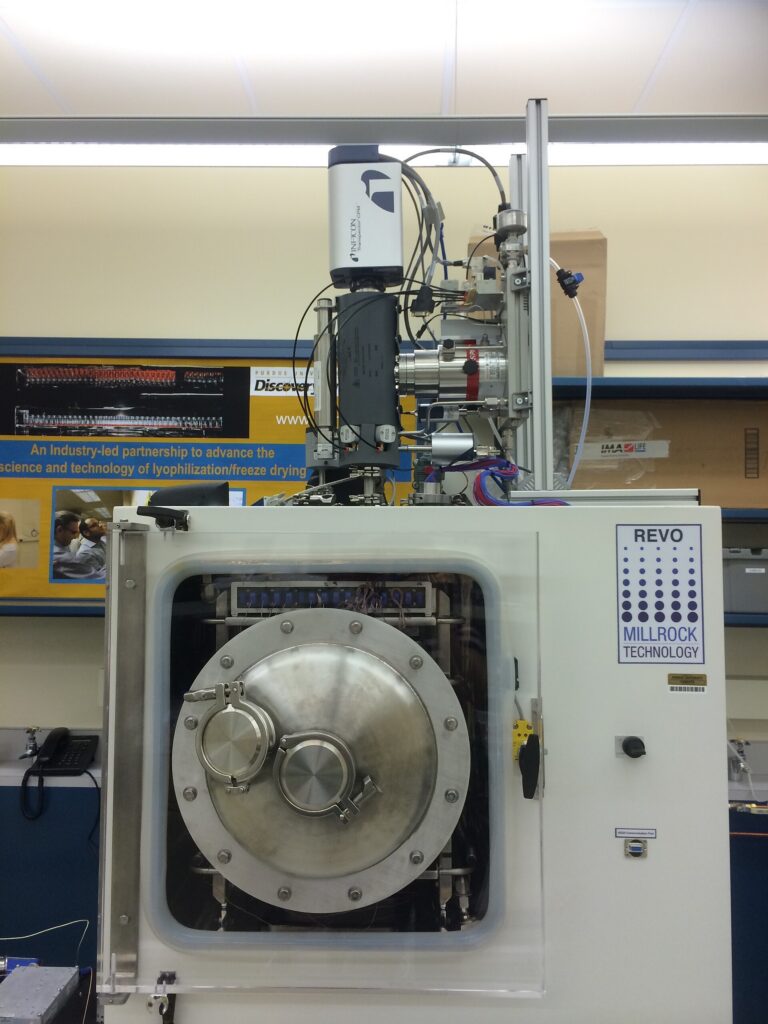
Freeze-drying removes water by sublimation, leaving an amorphous solid in which molecular motion, and therefore chemistry, nearly stops. Every reaction above except oxidation requires water as reactant, solvent, or catalyst, and oxidation is greatly slowed when the molecules cannot diffuse. This is why research peptides ship as lyophilized powder: properly stored, sealed vials remain stable for extended periods that solutions never approach. The powder’s remaining vulnerabilities are moisture (which restarts the chemistry; hence desiccant and warming the vial before opening) and, for oxidation-prone sequences, light and oxygen.
Reading a Sequence for Its Weak Points
| Residue or motif | Reaction | Mass change | Defense |
|---|---|---|---|
| Methionine (M) | Oxidation to sulfoxide | +16 Da | Degassed diluent, minimal air, dark |
| Cysteine (C) | Disulfide formation, scrambling | −2 Da per bond | Exclude thiols unless intended; avoid alkaline pH |
| Tryptophan (W), Tyrosine (Y) | Photo-oxidation | +16/+32 Da | Amber vials, dark |
| Asn-Gly, Asn-Ser | Deamidation | +1 Da | Mildly acidic pH, cold, fresh solutions |
| Asp-Gly | Isomerization | 0 | Cold, fresh solutions |
| Asp-Pro | Hydrolysis | Fragments | Avoid pH extremes and heat |
| Long, acylated, or hydrophobic | Aggregation | Loss of peak area | Low-binding tubes, no shaking, moderate concentration |
Full-length TB-500 has a methionine; Semax begins with one. Kisspeptin and the melanocortin analogs carry tryptophan. AOD-9604 and Cagrilintide have disulfide bonds. The acylated GLP-class compounds are the aggregation candidates. GHK-Cu adds a special case: its copper is redox-active and can be stripped by chelators.
How Degradation Shows Up in Data
Degradation rarely announces itself. More often it appears as a drift in potency between experiments run weeks apart, a widening of variance, or a result that fails to replicate from a fresh vial. On a re-run HPLC it shows as new peaks near the main one (modified sequences), a drop in main-peak area (aggregation or adsorption), or new early-eluting peaks (hydrolysis fragments). If a result changes when the vial changes, degradation of the old solution is the first hypothesis to test.
Laboratory Implications
The practical rules follow directly: store sealed vials cool, dry, and dark; warm the vial to room temperature before opening to prevent condensation; reconstitute gently in bacteriostatic water (see Reconstitution Basics); refrigerate solutions and use them within weeks; aliquot and freeze once rather than cycling; minimize air and light exposure for oxidation-prone sequences; and document lot numbers against the batch Certificate of Analysis so material age and handling history stay traceable in research records.
All products referenced are intended strictly for in-vitro research and laboratory use only. They are not for human or veterinary use, consumption, or therapeutic application.