


Triple incretin receptor agonists are arguably the most closely watched compound class in metabolic research. It is the first prominent triple receptor agonist: a single engineered peptide that activates the GLP-1, GIP, and glucagon receptors simultaneously. This overview covers why glucagon, the hormone that raises blood sugar, was added to a metabolic compound at all, how a peptide can be made to activate three receptors, what the research record shows, and how laboratories work with the class.
The Glucagon Question
Glucagon is the counter-hormone to insulin: released from pancreatic alpha cells when glucose is low, it drives the liver to release stored glucose. Adding glucagon receptor activity to a metabolic compound sounds backward. The logic comes from glucagon’s other effects. It increases energy expenditure, promotes fat oxidation in the liver, reduces liver fat, and suppresses incretin-pathway. In the 2000s researchers showed in rodents that glucagon’s glucose-raising effect could be offset by simultaneous GLP-1 receptor activation, which boosts insulin and suppresses endogenous glucagon, leaving the energy-expenditure and liver effects as a net gain. Oxyntomodulin, a natural gut hormone that activates both GLP-1 and glucagon receptors, was the proof of concept from nature.
What a Triple Incretin Agonist Is
Structurally, the leading triple agonist is a 39-residue peptide built on a GIP backbone, with substitutions that confer activity at the GLP-1 and glucagon receptors, an Aib residue for DPP-4 resistance, and a C20 fatty diacid on a lysine for albumin binding and a week-scale half-life. Designing it is harder than designing a dual agonist because the three receptors have partly conflicting sequence preferences: residues that favor glucagon receptor binding tend to weaken GLP-1 receptor binding, and vice versa. The published compound is balanced with GIPR activity highest, GLP-1R activity lower, and glucagon receptor activity lowest, a deliberate tuning to keep the glucose-raising arm in check. It represents the third generation of incretin-based design: single GLP-1 agonists came first, dual GIP/GLP-1 agonists second, and the triple agonist class extends the logic one receptor further.
Why Three Receptors
Each receptor contributes a distinct mechanism to the published pharmacology. GLP-1 receptor activation drives glucose-dependent insulin response, slows gastric emptying, and signals gastric signaling centrally. GIP signaling adds a second incretin axis and effects in endocrine tissue (see Dual Incretin Receptor Agonists). The glucagon component introduces an energy-expenditure and hepatic fat-oxidation dimension absent from earlier generations. In preclinical models, the triple agonist produced greater metabolic and liver-fat reduction than matched dual agonists, with the difference attributed to the glucagon arm. The published phase 2 literature made the compound a landmark in the field and triggered enormous research interest in triple agonism as a design principle.
Open Questions
- The right balance. How much glucagon receptor activity is optimal, and whether the answer differs between rodents and humans, is unsettled. Glucagon receptor activity can also raise heart rate and affect amino-acid metabolism.
- Energy expenditure in humans. The glucagon-driven increase in energy expenditure is robust in rodents; whether it contributes meaningfully in people, or whether incretin-pathway effects dominate, is being tested.
- Receptor cross-talk. Cells expressing two or three of these receptors may respond differently to a single tri-agonist than to a mixture of three selective agonists; this is testable in vitro and relevant to how the class works.
- Beyond three. Whether a fourth pathway (amylin, for instance) belongs in the same molecule or in a separate co-administered compound is the next design question; see The Multi-Agonist Era.
How Laboratories Study the Triple Agonist Class
Preclinical research uses triple-agonist compounds to dissect multi-receptor pharmacology: receptor binding and potency panels (cAMP accumulation at each of the three receptors expressed separately in cell lines), comparisons against single and dual agonists, and downstream studies of energy balance, hepatic lipid handling, and glycemic signaling in model systems. The canonical comparison set spans all three generations, single-agonist (GLP-1), dual-agonist (GLP-1/GIP), and triple-agonist (GLP-1/GIP/glucagon) compounds, run side by side. Because the three compounds have different potencies at the shared receptors, matching doses across arms is a design decision in itself: matching by GLP-1R activity, by mass, or by a functional endpoint each answers a different question. Glucagon receptor antagonists are available as tools to confirm that an effect depends on the third arm.
Handling Notes
The triple agonist is a 39-residue acylated peptide with the handling profile of the class: gentle reconstitution in bacteriostatic water, no shaking, low-binding tubes for dilute solutions, refrigeration, and protection from light. No methionine or cysteine. A Certificate of Analysis should confirm a mass near 4,731 Da and HPLC purity of 99% or better. Given three receptors and 39 residues, the number of near-miss impurities with their own activity profiles is large, which makes high purity and mass-spectrometric identity especially important (see Understanding Peptide Purity and Storing Lyophilized Peptides).
Research-Class Material
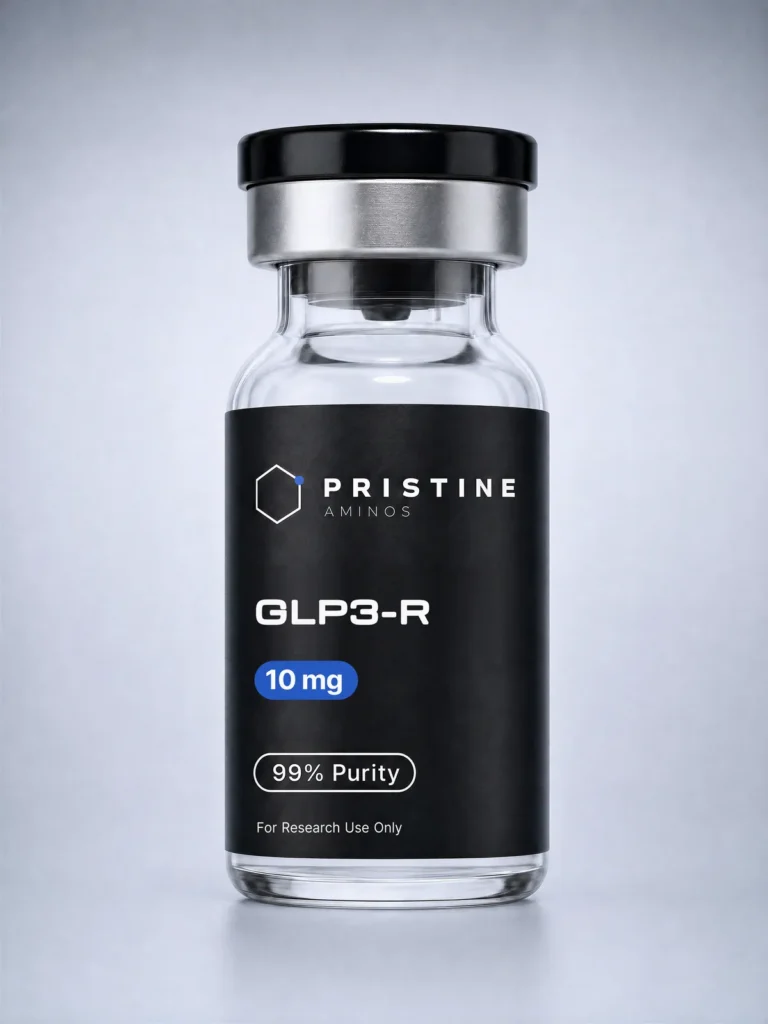
Pristine Aminos does not sell any prescription pharmaceutical. For laboratories studying this pathway, GLP3-R is our research-class triple agonist compound modeled on the triple-agonist class: manufactured in the U.S., third-party tested to 99%+ purity, and supplied with a Certificate of Analysis for research use. It sits alongside the dual-agonist and single-agonist compounds in our Metabolic Research collection, and the class context is mapped in our guide to single, dual, and triple agonists.
All products referenced are intended strictly for in-vitro research and laboratory use only. They are not for human or veterinary use, consumption, or therapeutic application.