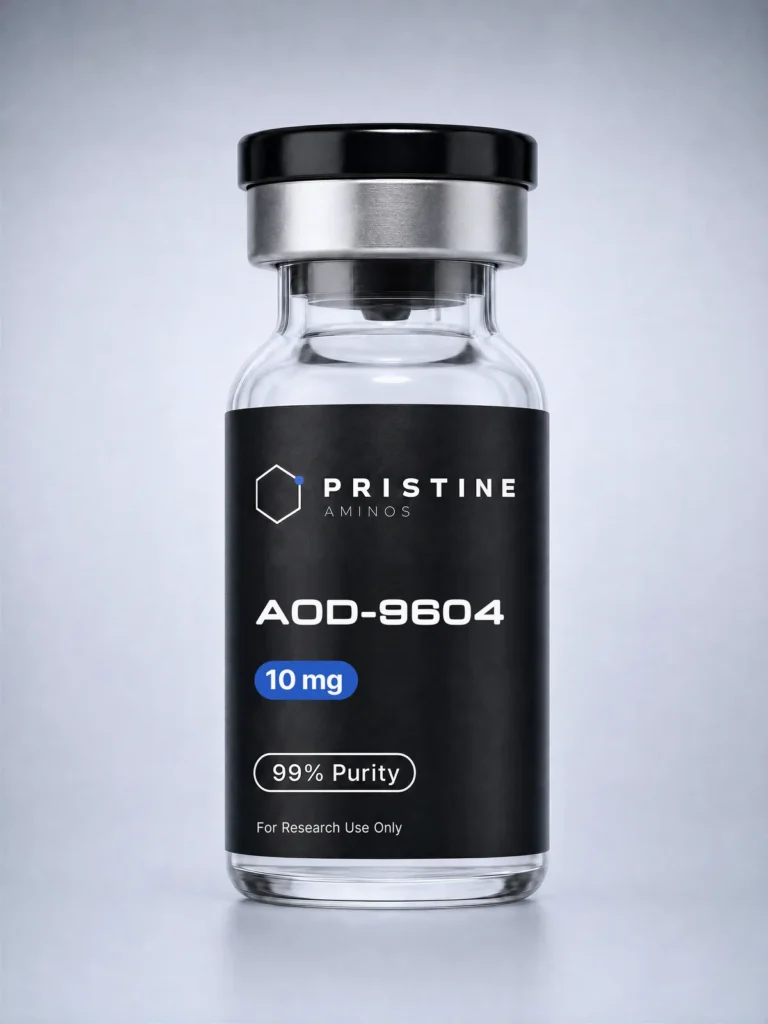


AOD-9604 is a synthetic fragment of human growth hormone that has had an unusual research career: it began as an attempt to isolate one function of a large hormone, went through a full clinical development program that did not reach its goal, and has since found a second life in laboratory research on fat metabolism and cartilage. This article explains what the molecule is, what the record shows, and how laboratories should approach it.
What AOD-9604 Is
Human growth hormone (hGH) is a 191-amino-acid protein with many actions: it drives growth through IGF-1, raises blood glucose, and promotes the breakdown of stored fat (lipolysis). Researchers in Australia in the 1990s asked whether the fat-related activity could be separated from the rest. They found that a short piece of the C-terminal end of the molecule, residues 177–191, retained lipolytic activity in animal and tissue models without the growth- or glucose-related effects.
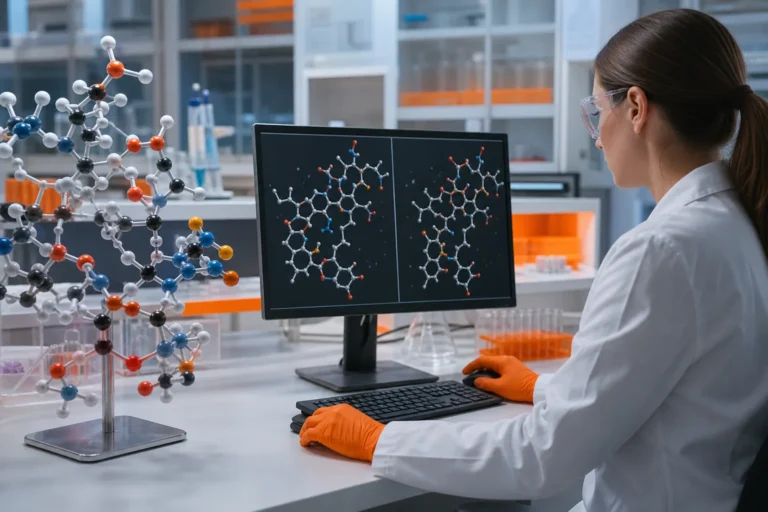
AOD-9604 (“Anti-metabolic disease Drug 9604”) is that fragment, hGH 177–191, with a tyrosine added at the N-terminus to improve stability. It is a 16-residue peptide containing a disulfide bond between two cysteines, with a molecular weight of about 1,815 Da. The disulfide gives it a defined loop structure that matters for both activity and handling.
The Preclinical Record
Lipolysis and fat oxidation
Studies in rodents and in isolated fat tissue from the late 1990s and early 2000s reported that the fragment increased breakdown of stored triglycerides and fat oxidation, and reduced fat accumulation in metabolic-model mouse models, without changing feeding-pathway and without the insulin-resistance effect of full-length growth hormone. A proposed mechanism is action on the beta-3 adrenergic receptor pathway in endocrine tissue, though the fragment does not bind the growth hormone receptor itself, and the exact target remains a research question.
No IGF-1 or growth effects
A consistent finding across the preclinical work is that the fragment does not raise IGF-1 and does not reproduce growth hormone’s effects on glucose. This is both the point of the molecule and the reason it is useful in research: it allows the lipolytic arm of GH biology to be studied in isolation.
Cartilage and joint models
A later and smaller literature, mostly from Korean groups in the 2010s, examined AOD-9604 in animal models of osteoarthritis, alone and in combination with hyaluronic acid, with cartilage histology as the endpoint. These are preliminary animal studies but they opened a second research direction for the compound.
The Clinical Program
AOD-9604 is one of the few research peptides in our catalog that has been through human clinical trials. In the 2000s an Australian company ran a program of trials, including a large phase 2b study in metabolic-model adults, testing an oral formulation. The compound was well tolerated, but the weight-loss effect was too small to meet the trial’s goals and development for metabolic was discontinued around 2007. The material was later self-affirmed as GRAS (Generally Recognized As Safe) for use as a food ingredient in the United States.
For researchers, the clinical history is informative in two ways. The safety data from several hundred human participants is more than exists for most research peptides. And the failure to translate robust animal lipolysis into meaningful human metabolic is itself a well-documented case study in the limits of rodent fat-metabolism models.
Research Questions That Remain Open
- The receptor. The fragment’s lipolytic effect is not mediated by the GH receptor. Whether it acts through beta-3 adrenergic signaling, another receptor, or a non-receptor mechanism is unresolved.
- Species differences. Why rodent endocrine tissue responds strongly while human results were modest is unexplained and is relevant to anyone using rodent fat models.
- Cartilage effects. The joint literature is small and would benefit from replication and mechanistic work.
- Combination studies. AOD-9604 is sometimes studied alongside other metabolic compounds; its GH-independent mechanism makes it a useful contrast to growth-hormone-axis peptides such as Ipamorelin or CJC-1295, which act upstream by increasing GH release. Our overview of growth hormone secretagogues covers that axis.
Handling in the Laboratory
The disulfide bond is the main handling consideration. Reducing agents such as DTT or β-mercaptoethanol will open it and change the peptide’s structure, so they should be excluded from buffers unless that is the intent. The two cysteines also make the peptide susceptible to disulfide scrambling and oxidation at high pH or with prolonged air exposure; keep solutions near neutral pH, refrigerated, and protected from light.
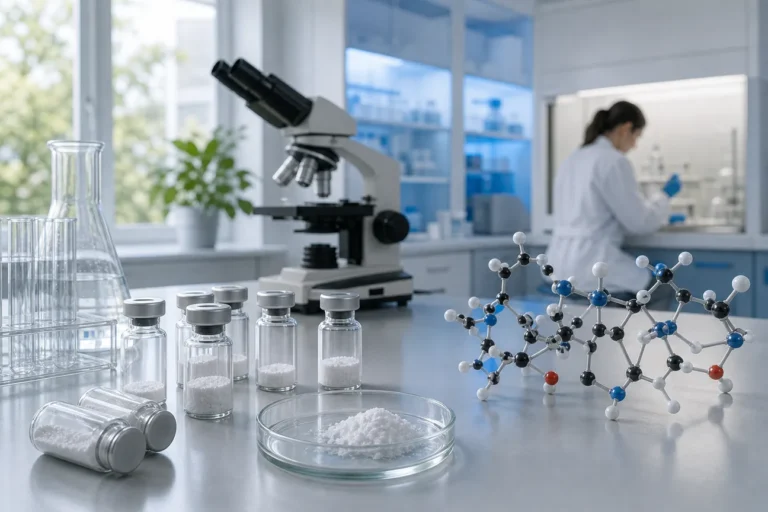
Lyophilized AOD-9604 is stable stored cold and dry. Let the vial reach room temperature before opening, reconstitute with bacteriostatic water added gently down the vial wall, and swirl rather than shake. Use the solution within a few weeks. Our guides to reconstitution and storage apply.
On the Certificate of Analysis, confirm identity by mass spectrometry (expected mass about 1,815 Da for the oxidized, disulfide-bonded form; a mass 2 Da higher indicates the reduced, open form) and HPLC purity of 99% or better. See What a COA Tells You.
Summary
AOD-9604 is a well-characterized fragment of growth hormone that separates lipolytic activity from the hormone’s growth and glucose effects. It has solid preclinical data in fat-metabolism models, an unusually large human safety dataset from a discontinued clinical program, an open question about its receptor, and a newer research thread in cartilage biology. For laboratories, it is a specific tool for studying GH-independent fat metabolism, with one handling rule: protect the disulfide.
Pristine Aminos supplies AOD-9604 as a lyophilized, third-party-tested research material in our General Research collection.
For laboratory and research use only. Not for human or veterinary use, consumption, or therapeutic application.