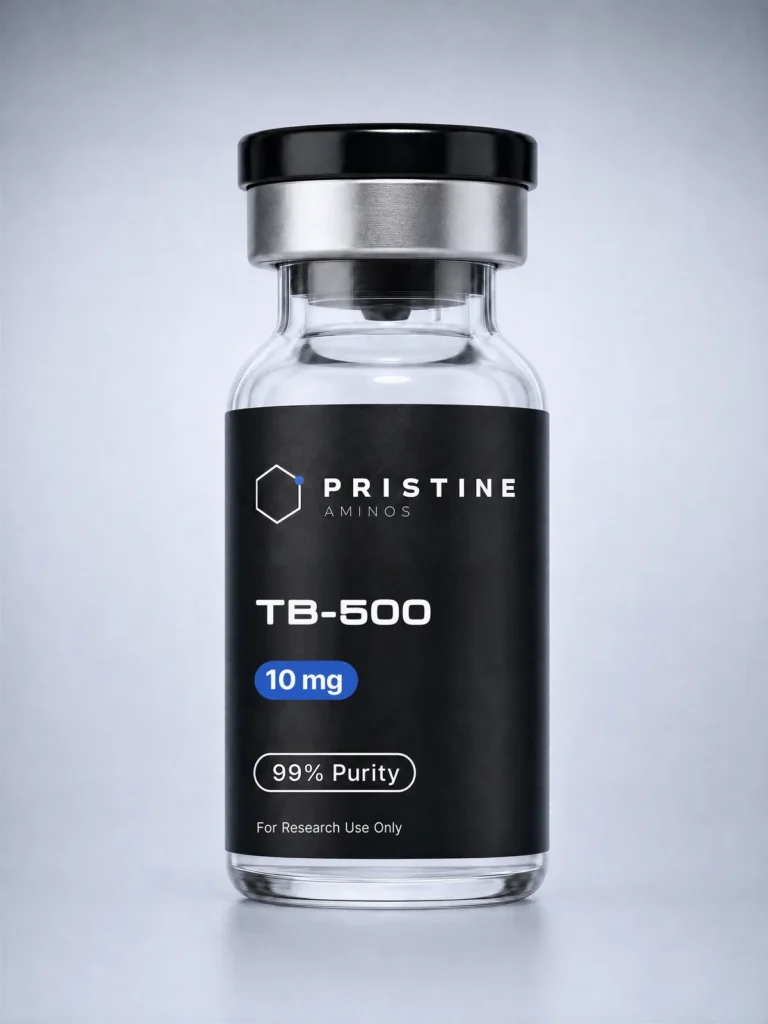


TB-500 is the name used in the research-supply market for synthetic thymosin beta-4 or its active fragment. Unlike many research peptides, the parent molecule is a protein your cells already make in large quantities, and its biology was worked out well before anyone sold it in a vial. This overview covers what thymosin beta-4 does inside the cell, what the preclinical and clinical literature has examined, and what laboratories should check before working with the material.
Thymosin Beta-4: The Parent Molecule
Thymosin beta-4 (Tβ4) is a 43-amino-acid peptide, about 4.9 kDa, first isolated from calf thymus in the 1980s. The thymus origin turned out to be incidental: it is present in nearly every cell type and is one of the most abundant small peptides in the cytoplasm, reaching concentrations of several hundred micromolar in platelets and white blood cells.
Its primary, well-established job is to bind monomeric (G-) actin. By holding actin monomers in reserve, Tβ4 regulates how quickly a cell can build and rebuild its cytoskeleton, which is the machinery behind cell movement, shape change, and division. This “actin-sequestering” role is textbook cell biology, not a speculative claim.
What “TB-500” Refers To
The research-market term is imprecise, and laboratories should read product specifications carefully. “TB-500” may describe the full 43-residue synthetic peptide or, more commonly, a shorter synthetic segment centered on the actin-binding domain, residues 17–23 (LKKTETQ), often N-terminally acetylated. The fragment retains actin-binding and cell-migration activity in vitro, which is why it is used as a stand-in for the full peptide. A Certificate of Analysis showing the observed molecular mass will tell you which form a given lot contains; the full-length peptide has a mass near 4,963 Da, while the 7-residue fragment is under 900 Da.
Research Themes in the Literature
Wound and dermal repair
Some of the earliest functional studies, from the National Institutes of Health in the late 1990s, used full-thickness skin wounds in rats and reported faster closure, increased keratinocyte migration, and more organized collagen deposition. In-vitro work with endothelial cells and keratinocytes documented increased migration, which fits the actin-regulation mechanism.
Cardiac tissue
A widely cited 2004 study in mice found that Tβ4 promoted survival of heart muscle cells and improved function after experimental coronary ligation. Follow-up work examined epicardial progenitor cell activation and the formation of new vessels. These studies are a major reason the peptide attracted sustained research interest.
Corneal and ocular models
Tβ4 has been studied in corneal wound models and in dry-eye research, and a synthetic form has progressed through clinical trials for ocular surface disorders. This is one of the few areas where human data exist for the parent molecule, although those trials involve a sterile ophthalmic formulation, not the research material sold to laboratories.
Inflammation and fibrosis
Tβ4 is cleaved in vivo to a tetrapeptide, Ac-SDKP, which has its own literature on anti-fibrotic signaling. Studies of the full peptide report reduced inflammatory cell infiltration and lower levels of several inflammatory cytokines in injury models.
Mechanisms Under Investigation
Three mechanisms recur. The first and best established is actin regulation, which directly explains the migration effects. The second is downregulation of inflammatory signaling, with several papers pointing to reduced NF-κB activity. The third is a pro-survival effect traced through the integrin-linked kinase (ILK) and Akt pathway. Unlike some research peptides, Tβ4 has defined molecular interactions, which makes it a comparatively clean tool for cytoskeletal and migration assays.
Handling in the Laboratory
Full-length Tβ4 has one methionine residue (position 6) and is susceptible to oxidation, so solutions should be protected from air and light and used promptly. The short fragment is more robust. Both are supplied lyophilized and should be stored cold and dry; after reconstitution with bacteriostatic water, refrigerate and use within a few weeks. Our storage guide and reconstitution guide cover the details.
Because the market term covers more than one molecule, identity confirmation by mass spectrometry is the single most important line on the Certificate of Analysis for this product. See what a COA tells you.
TB-500 in Combination Studies
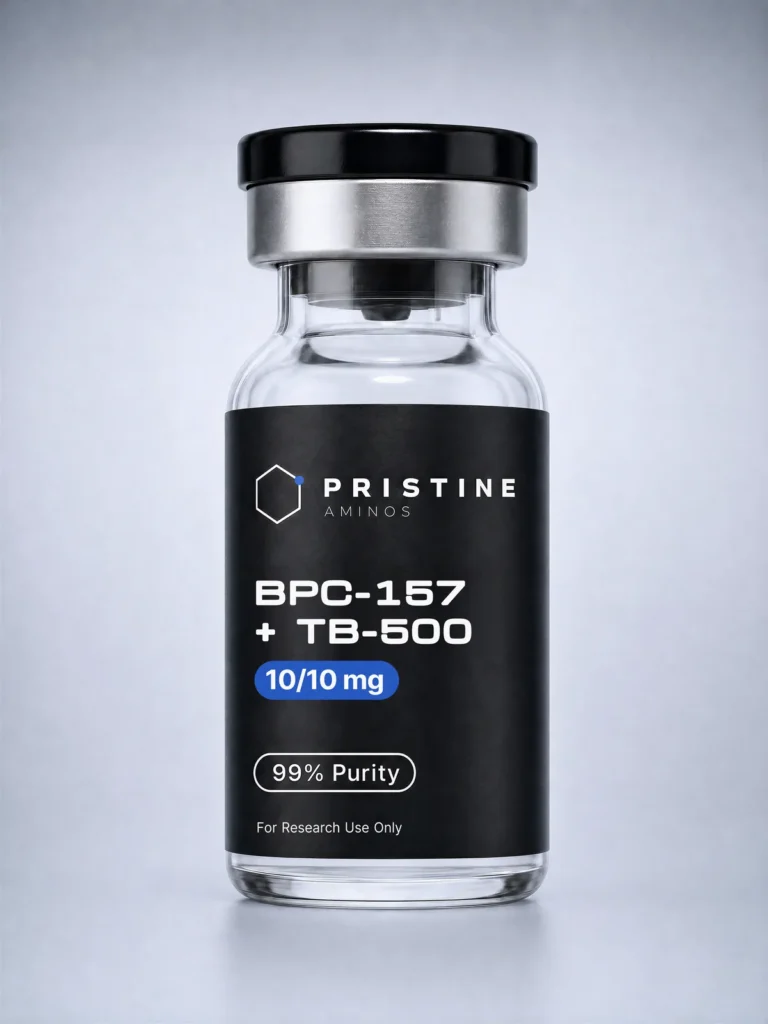
TB-500 is often studied alongside BPC-157 because the two approach tissue repair from different angles: one through cytoskeletal regulation and cell migration, the other through proposed angiogenic and growth-factor signaling. We compare the two in BPC-157 vs TB-500. The pair is available as a matched-lot BPC-157 + TB-500 blend, and both appear with GHK-Cu in the GLOW and KLOW multi-peptide blends.
Summary
Thymosin beta-4 is unusual among research peptides in having a well-defined endogenous role, a known binding partner (actin), and a literature that spans cell biology, animal injury models, and clinical trials of an ophthalmic form. The practical caveat for laboratories is nomenclature: confirm which form of the molecule a given lot contains before designing an experiment around it.
Pristine Aminos supplies TB-500 as a lyophilized, third-party-tested research material in our Tissue Research collection.
For laboratory and research use only. Not for human or veterinary use, consumption, or therapeutic application.