

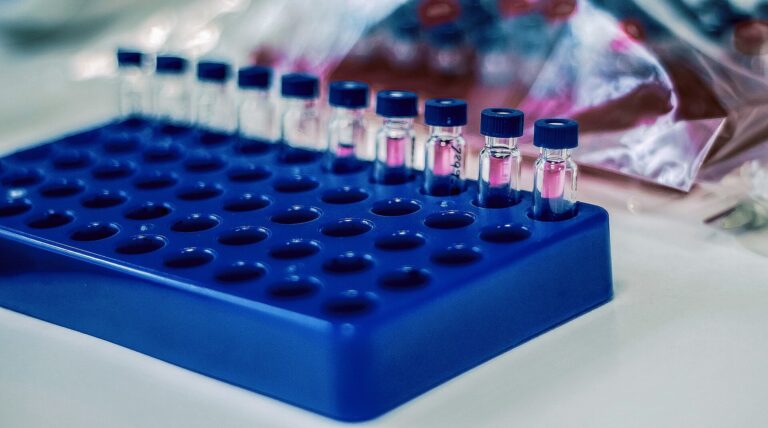
A peptide blend is two or more research compounds supplied together in a single lyophilized vial. Blends have become common in the research-supply market, and they raise fair questions: why combine compounds at all, what does the laboratory gain or lose, and how should a blended product be characterized? This article answers those questions and explains the reasoning behind each of our blends.
Why Researchers Combine Compounds
Most biological processes involve several pathways at once. Tissue repair, for example, requires cells to migrate into a wound, new blood vessels to form, matrix proteins to be laid down and remodeled, and inflammation to resolve. No single peptide addresses all of those steps, so researchers studying the whole process often work with compounds that act on different parts of it.
Combining them in one vial has three practical advantages. Matched lots: every experiment draws from the same ratio and the same batch, which removes a source of variability when reconstituting from separate vials. Simpler protocols: one reconstitution step instead of three or four reduces handling error. Cost: a blend is usually less expensive than the equivalent set of single-compound vials.
What a Blend Gives Up
The trade-off is flexibility. In a blend the ratio is fixed, so a laboratory cannot vary one component while holding the others constant. For mechanistic work that asks “which compound is responsible for this effect?”, single vials are the right tool and the blend is the wrong one. Blends suit experiments where the combination itself is the thing being studied, or where a well-characterized multi-compound preparation is wanted as a positive control.
Characterization is also more demanding. A Certificate of Analysis for a blend must identify each component by mass spectrometry and should report purity for each, since an HPLC chromatogram of a blend shows multiple major peaks and a single “purity” number is less meaningful. Our guide to reading a COA explains the fields; for blends, look specifically for a per-component identity confirmation.
Our Blends and the Reasoning Behind Each
BPC-157 + TB-500 (“Wolverine”)
The most common two-compound pairing in tissue-repair research. BPC-157 is studied for proposed angiogenic and growth-factor signaling; TB-500 is a fragment of thymosin beta-4, whose established role is regulating actin and therefore cell migration. The two mechanisms are complementary, which is why they are so often studied together. Available as BPC-157 + TB-500; the compounds are compared in BPC-157 vs TB-500.
GLOW (GHK-Cu + BPC-157 + TB-500)
GLOW adds GHK-Cu to the pair above. GHK-Cu contributes a third mechanism: copper delivery and modulation of collagen synthesis and matrix remodeling enzymes. The three-compound set covers migration, vascular signaling, and matrix remodeling, which is why it is used in skin and connective-tissue models.
KLOW (GHK-Cu + BPC-157 + TB-500 + KPV)
KLOW is GLOW plus KPV, a tripeptide fragment of alpha-MSH studied for anti-inflammatory signaling in gut and skin barrier models. The addition targets the inflammation-resolution step of repair that the other three do not directly address. See KLOW vs GLOW for a side-by-side.
CJC-1295 + Ipamorelin
This blend comes from a different field: growth-hormone axis research. CJC-1295 (without DAC) is a GHRH analog that acts on the pituitary GHRH receptor; Ipamorelin is a selective ghrelin-receptor agonist. The two receptors act on the same pituitary cells through different signaling pathways, and their combination has been studied for additive effects on growth hormone release in preclinical models. Available as CJC-1295 + Ipamorelin; background in GHRH Analogs vs Ghrelin Receptor Agonists.
Tesamorelin + Ipamorelin
The same two-pathway logic with a different GHRH analog. Tesamorelin is a full-length, stabilized GHRH; paired with Ipamorelin as Tesamorelin + Ipamorelin.
Selank + Semax
Two Russian-developed neuropeptides with different parent molecules: Semax is an ACTH(4-10) analog studied for BDNF expression, while Selank is a tuftsin analog studied for GABAergic and anxiety-related signaling. Supplied as Selank + Semax; compared in Semax vs Selank.
Handling Blends in the Laboratory
A blend’s components may have different stabilities. In GLOW and KLOW, for example, GHK-Cu is sensitive to chelating buffers and TB-500 contains an oxidizable methionine, so the blend should be handled to the standard of its most fragile component: non-chelating diluent, protection from light, refrigerated after reconstitution, and used within a few weeks. Reconstitute with bacteriostatic water added slowly down the vial wall and swirled, not shaken, to avoid foaming and aggregation. See Reconstitution Basics and Storing Lyophilized Peptides.
Summary
Blends exist because biology is multi-pathway and because matched-lot preparations reduce variability. They are the right choice when the combination is the object of study and the wrong choice when the question is which component does what. Either way, insist on a Certificate of Analysis that identifies every component individually.
All Pristine Aminos blends are lyophilized and third-party tested. Browse them in the Tissue Research, Endocrine Signaling Research, and Neuropeptide Research collections.
For laboratory and research use only. Not for human or veterinary use, consumption, or therapeutic application.